
Marshall County Release Date Labels
Three dates answer three different questions. The Release Eligibility Date, usually shortened to RED, is the first date an otherwise eligible Tennessee offender may be considered for parole. TDOC calculates RED, but the Tennessee Board of Parole makes the parole decision. Eligibility does not require a grant. Even a grant does not show that the person left, because a release plan and other conditions may still need approval.
A projected, tentative, or sentence-expiration date is an administrative calculation. It can reflect the sentence structure, jail credit, and only the credits allowed by the law that governs the offense. The actual release date records when a person left the holding agency. Only that last event proves departure. Even then, the destination matters because departure can be a community release, parole, a transfer, or a detainer handoff.
| Date label | What it means | What it does not prove |
|---|---|---|
| Release Eligibility Date | First potential parole consideration date under the controlling law | A favorable Board decision or physical release |
| Projected or tentative date | Current administrative calculation based on sentence and allowed credits | That no later event can change the calculation |
| Sentence expiration | Calculated end of the custodial sentence or term as labeled | That no supervision, detainer, or other sentence remains |
| Actual release date | Recorded date custody with that agency ended | Release to the community rather than transfer to another authority |
Find a Marshall County Projected Date
The search begins with custody type. A pretrial detainee at Marshall County Jail does not have a sentence-based projected release date. Bond may be set, changed, paid, denied, or blocked by another hold. The court can enter an order, while the jail later records physical processing. Call the Sheriff’s Department for current custody and request the booking or release sheet for a past event. Use the court file for bond and disposition.
A person serving a county-jail sentence requires the judgment, sentence length, jail-credit entry, and concurrent or consecutive structure. Concurrent terms run together; consecutive terms run one after another. The jail’s own computation is needed. No official Marshall County good-time or weekend-release policy was found, so a rule from another Tennessee county must not be used.
- Identify the last confirmed custodian and whether the person is awaiting trial, serving a county sentence, or serving a TDOC sentence.
- Obtain the exact conviction statute, offense date, sentence length and range, jail credit, and concurrent or consecutive terms from the court record.
- For state custody, search TDOC FOIL by TDOC ID when possible, then confirm the correct person and current status.
- Read each date exactly as the live record labels it. Do not rename RED as a release date.
- For county custody, ask the jail for the existing calculation or release record and pair it with the sentencing judgment.
- Confirm the actual custody exit and receiving authority with the maintaining agency.
Note: A court order explains legal authority, while the jail or TDOC record confirms when the physical custody event occurred.
Marshall County TDOC FOIL Dates
The TDOC Felony Offender Information Lookup introduction says FOIL provides current status, location, photograph, and active sentences for current and former Tennessee felony offenders without charge. It does not cover every person whose Marshall County event was limited to a misdemeanor or pretrial jail stay. Statewide scope matters because no TDOC prison was verified inside Marshall County and a sentenced person may be housed anywhere TDOC assigns.
The live form accepts last name, first name, race, and an include-alias option. It also supports TDOC ID and State ID searches and uses a case-sensitive image CAPTCHA or audio challenge. Open the correct profile, inspect current status and location first, then study the active sentence and date fields. A prison location shows ongoing state custody. Community supervision supports release from prison but not full discharge.
| FOIL input or field | How to use it |
|---|---|
| TDOC ID | Best starting point for reducing same-name errors |
| State ID | Alternate official identifier when known |
| Name, race, aliases | Broader route that requires close identity matching |
| Status and location | Read before any sentence date to determine present custody context |
| Photograph and active sentences | Help confirm identity and the case tied to the calculation |
| Date label on live result | Preserve the exact label and do not infer a field not shown |
The official FOIL search image shows the fields and challenge available to a Marshall County state-offender search.
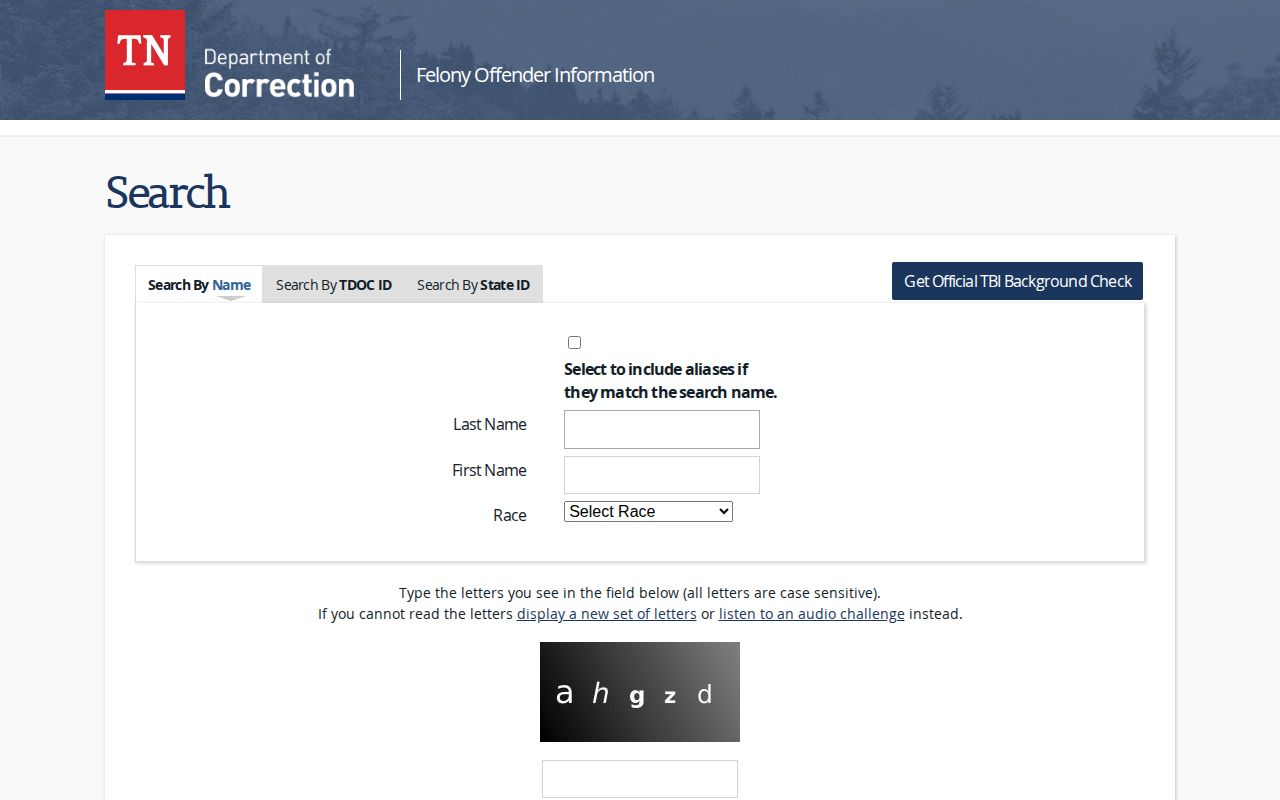
The screenshot does not supply a projected date for a named person; a lawful live result must control the exact current date wording.
Marshall County Sentence Date Calculation
A safe Tennessee calculation starts with the offense date and exact conviction statute. Next come sentence length, range, concurrent and consecutive terms, and credited pretrial jail time. TCA § 40-35-501 governs release eligibility. General range classifications can correspond to 30, 35, 45, or 60 percent before eligibility, but special subsections can override those general figures. The version in force for the offense date matters.
TCA § 41-21-236 governs sentence-reduction credits. Good behavior and satisfactory program performance can produce credits, and credits can be lost. Their effect on RED or sentence expiration varies with the controlling version of the statutes. A person cannot take the total sentence, subtract a broad statewide percentage, and obtain a reliable Marshall County projected release date.
- Jail credit
- Time credited by the court for qualifying custody before the sentence.
- Sentence-reduction credit
- A credit earned under applicable law that may affect a calculation and may be lost.
- Detainer
- A request or authority that can send a person to another custodian instead of the community.
- Rescission
- Cancellation of a parole grant before physical release.
After applying the controlling provisions, compare the work with TDOC’s displayed calculation. Do not promise a result. If a figure differs, ask TDOC or the jail for the maintained calculation record instead of guessing which factor changed.
Marshall County 85-Percent Rule Limits
The common claim that every Tennessee inmate serves 85 percent is wrong. For specified offenses committed on or after July 1, 2022, Tennessee’s truth-in-sentencing framework requires service of 100 percent less only permitted credits. Those credits cannot reduce actual service below an 85-percent floor. The rule is tied to covered offenses and dates, not to every state or Marshall County sentence.
Some offenses have different required percentages or no ordinary parole eligibility. Later amendments enacted in 2024 changed how credits affect eligibility or expiration for relevant offense-date groups. The exact statute and effective version must be applied to the conviction rather than relying on a short label in an online discussion.
The 2022 enacted truth-in-sentencing bill supplies the official text for the covered framework, and the 2024 amendments show why the offense-date analysis must remain current. These laws explain a calculation but do not establish actual release.
Note: Statutory percentages govern eligibility or credit effects only as the applicable offense and effective-date provisions direct.
Why Marshall County Release Dates Change
A projected date is a snapshot of the facts and rules then applied. A new order or credit adjustment can move it. A detainer may leave the date when TDOC custody ends unchanged while altering the destination. Likewise, parole eligibility may arrive without a grant, and a grant may later be rescinded before the gate event.
| Factor | Possible effect | Best confirming record |
|---|---|---|
| Earned credits | May alter eligibility or expiration as the controlling law permits | TDOC calculation and credit record |
| Disciplinary credit loss | May move a current projected calculation later | TDOC maintained record |
| Jail credit correction | Can change the starting credit applied to a term | Court order and custodian calculation |
| Concurrent or consecutive correction | Changes whether terms overlap or follow one another | Judgment and amended orders |
| New charge or detainer | Can continue custody with another authority | Release authorization and receiving-agency record |
| Parole grant, denial, or rescission | Affects the release path without itself proving departure | Board final disposition plus TDOC release record |
| Revocation | Can create a new custody event after release | Board or court order and custody record |
When records conflict, each may describe a different step. A Marshall County court order, a jail transfer, a TDOC release authorization, and a new county booking can all be correct on the same day. Keep the labels, times, and receiving authority intact.
Confirm Marshall County Actual Release
For a county-jail sentence, request the release date and time, release type, and receiving authority from the Marshall County Sheriff’s Department. Ask the Circuit Court Clerk for the judgment, sentence, jail-credit entry, and any amended order. No official local good-time or weekend-release rule was verified, so the jail’s existing computation is the proper source for a difference from a simple calendar count.
The Marshall County Circuit Court Clerk is the local records route for the criminal portions of Circuit and General Sessions Court. Ask for the exact documents, not a new calculation: the judgment, sentencing order, jail-credit entry, docket, and any order that later changed the term. The court file can establish the legal sentence, while the jail record supplies the physical release time. A noon court order and a later transfer can both be accurate because they describe different stages of the same custody event.
For TDOC, read FOIL’s current status and request archived offender records when an exact past discharge matters. Useful requested items include the release or discharge date and type, sentence expiration, parole certificate or final disposition, supervision dates, and receiving authority after transfer. Board Operations can provide a final parole disposition. District 50 is the Marshall County state-supervision route after release.
VINE can provide prospective notice for a participating source, but an alert must be read for the event it reports. A TDOC release on a county detainer can lead straight into county custody. The Marshall County VINELink check explains how to register and why the receiving custodian must still be identified. For a complete named-person search across county, state, and federal systems, use the Marshall County released-inmate record path.
The final test is simple: identify which agency’s custody ended, when it ended, why it ended, and where the person went. A date without those four points is not a complete release answer.
Note: Preserve each official date label because eligibility, expiration, transfer, supervision start, and actual release are not interchangeable events.