
Marshall County Parole vs Probation
Parole and probation can both place a released Marshall County person in the community under rules, but they arise in different ways. The Tennessee Board of Parole decides whether an eligible state prisoner may receive parole. Tennessee Department of Correction, or TDOC, calculates the Release Eligibility Date and supervises a parolee after release. A Board grant is conditional. The release plan still must be approved, other pre-release conditions may remain, and the grant may be rescinded before the person leaves custody.
Probation is imposed by a court. TDOC Community Supervision handles state probationers and other state release types, while Marshall County Probation handles local misdemeanor cases within its stated scope. The judgment is the key routing record because a jail departure sheet alone may say “probation” without identifying the supervising system. Split confinement means part of a sentence is served in custody and the rest on probation. It can create an immediate reporting duty after release.
| Point | Parole | Probation |
|---|---|---|
| Who orders it | Tennessee Board of Parole after an eligibility process | The sentencing court |
| Who supervises | TDOC Community Supervision | TDOC for state cases or Marshall County Probation for covered misdemeanors |
| What to verify | Final Board disposition, TDOC custody exit, and supervision status | Judgment or probation order, release record, and correct supervising office |
| How it ends | Formal completion or discharge, unless revoked or another term applies | Completion or discharge under the order, unless revoked or extended by lawful process |
- Parole
- Conditional service of part of a state sentence in the community.
- Probation
- Court-ordered supervision that may replace or follow confinement.
- Discharge
- The formal end of the supervising authority, not merely release from a cell.
- Absconder
- A supervision classification that must be confirmed through official records, not guessed from an address or missed contact.
Verify Marshall County Post-Release Supervision
Start with the last known custodian and the sentence. A person held only for a local misdemeanor may never appear in the state felony system. A person transferred from Marshall County Jail to TDOC, by contrast, should be traced through the state system. The TDOC Felony Offender Information Lookup, known as FOIL, covers people who are or have been in Tennessee felony custody. Search by TDOC ID when possible, or use name, race, and the alias option. Match the photo and identifiers before relying on the status.
FOIL is a public starting point, not a complete decision archive. A prison location points to current incarceration. A community-supervision status supports release from a prison setting while showing that state control continues. When an exact discharge date or type matters, request the archived offender record from TDOC. County misdemeanor supervision instead begins with the judgment and the official Marshall County Probation office.
- Obtain the jail release or transfer sheet and the sentencing judgment from the correct Marshall County court.
- Determine whether the order names TDOC supervision, parole, state probation, or Marshall County misdemeanor probation.
- For a state felony case, search FOIL and compare the TDOC ID, name, photograph, current status, location, and active sentence data.
- For parole, obtain the final disposition from Board Operations and confirm the physical custody change through TDOC.
- Contact District 50 or Marshall County Probation, as appropriate, for clarification that may be disclosed.
- Request a formal discharge or archived supervision record when the end date must be proved.
Note: A Board hearing, recommendation, or grant is not the same record as actual release from TDOC custody.
Marshall County TDOC District 50
The TDOC field office directory places Marshall County in District 50. The Lewisburg office serves as the local state-supervision contact. Its directory entry is not a public person-by-person roster. It helps route a verified state case to the right office after FOIL and the judgment establish that TDOC has authority.
TDOC Marshall Community Supervision203 First Avenue North
Lewisburg, TN 37091
Phone: 615-218-4255
Fax: 615-848-5110
The published 615 telephone number is correct even though the office is in Lewisburg. District 50 also serves Bedford, Cannon, Coffee, Franklin, Lincoln, Moore, and Rutherford Counties, so the office directory is regional. Supervision can also occur out of state. FOIL help cautions that another jurisdiction may supply some data, which makes the originating order and official records important when locations conflict.
The official District 50 screenshot shows where Marshall County state supervision is routed. The TDOC directory is the source for the office entry.
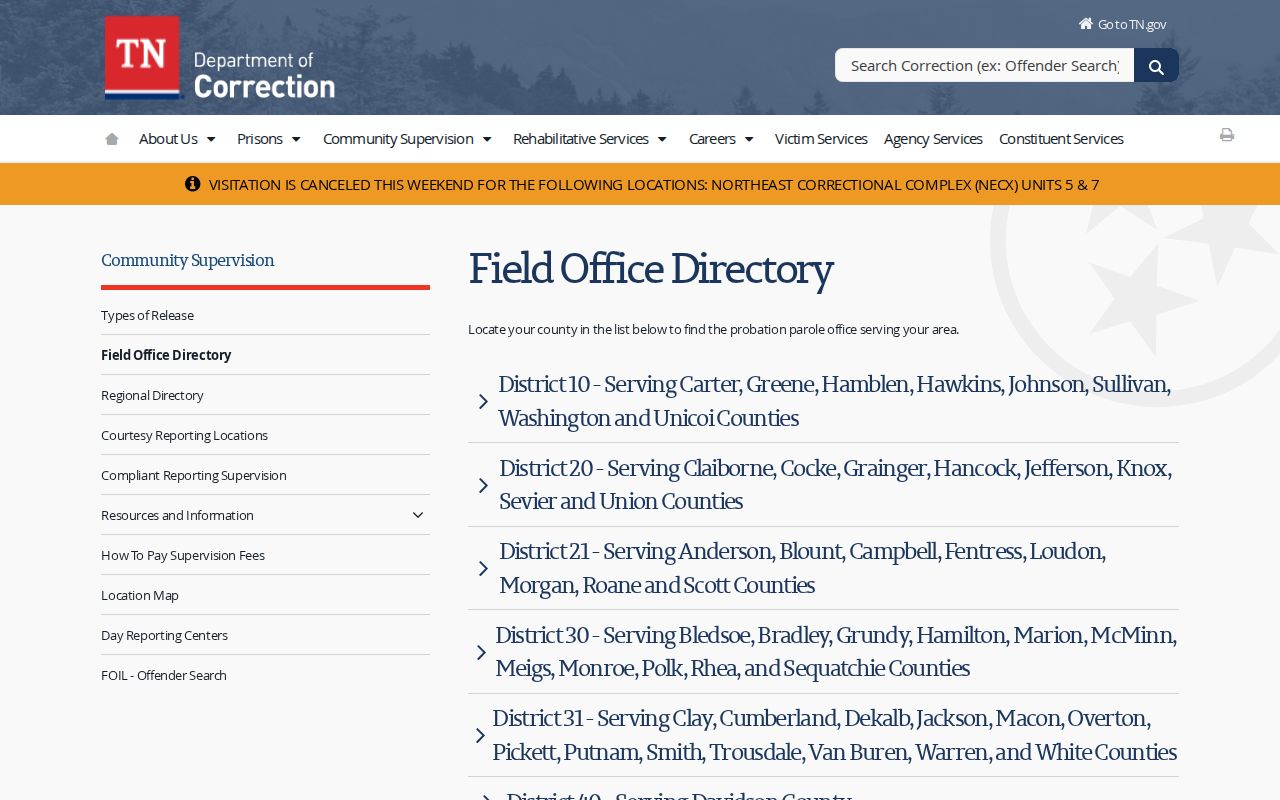
Use that office entry only after the sentence or FOIL record points to state community supervision.
Marshall County Misdemeanor Probation
Marshall County Probation is separate from TDOC and the Board of Parole. Its official page identifies Director Linda Bassham and says the office handles misdemeanor criminal offenses carrying a maximum jail sentence or probation term of 11 months and 29 days per offense. The office is not a general released-inmate locator. A court judgment placing a person there is the basis for using this channel.
Marshall County Probation206 Legion Avenue, Suite B
Lewisburg, TN 37091
Phone: 931-359-0343
Fax: 931-359-7435
Email: lbassham@marshallcountytn.gov
Reporting: Monday, Tuesday, Thursday, and Friday, 7:30 a.m. to 5:30 p.m.
The Marshall County Circuit Court Clerk directory identifies the local criminal-record contact for Circuit, General Sessions, and Juvenile Courts. General Sessions is often the first local file for a misdemeanor probation event, while felony judgments may route through Circuit Criminal and TDOC. Ask for the judgment, probation order, any split-confinement terms, later revocation filings, and a satisfaction or discharge document. A release sheet confirms when jail custody ended. The court order explains why and under whose supervision.
Local probation and state supervision can both apply to people who left custody in Marshall County, but the offices do not share the same role. Verify the case first. The broader Marshall County released-inmate search and records path explains how jail and court records fit together.
Marshall County 48-Hour Reporting Rule
TDOC states that a probationer must report to the probation and parole officer within 48 hours after being placed on probation or released from split confinement. This rule makes the first days after a Marshall County custody exit important. The jail record may show a physical release, while the judgment and TDOC supervision record show a duty that begins at once.
The 48-hour state rule should not be copied onto every local probation case without checking the order. Marshall County Probation publishes its own reporting schedule, and the court controls the local terms. Nor should the District 50 office be treated as part of the Sheriff’s Department. The offices are close in downtown Lewisburg, but they answer different questions. The Sheriff confirms the local custody exit. TDOC confirms state supervision as disclosure rules permit.
A missed report can have serious consequences, yet it is not sound proof of a warrant or absconder status. Verify any official action with the supervising agency, issuing court, and law enforcement record. Personal assumptions should never replace a docket entry or warrant confirmation.
Note: Physical closeness between the jail and District 50 does not merge their staff, authority, files, or release duties.
Marshall County State Release Types
TDOC identifies several forms of community supervision. They include parole, probation, determinate release, Community Corrections, mandatory reentry supervision, and Community Supervision for Life. Each label has a different legal source. Determinate release can apply to qualifying felony sentences of at least one year but no more than two years after at least 30 percent is served, with notice and objection procedures. Mandatory reentry under TCA § 40-35-506 applies to relevant offenses committed on or after July 1, 2021.
Community Supervision for Life under TCA § 39-13-524 can remain after prison, probation, and parole would otherwise end for an applicable conviction. That is why “off probation” does not always prove complete state discharge. The exact conviction, offense date, sentence, and TDOC record control. The official TDOC types of release page provides the state descriptions, while a court judgment and offender record apply them to one person.
VINE may provide notice of a custody change for a participating source, but it is not a broad supervision database. TDOC has verified statewide VINE coverage for people in its custody. Marshall County jail participation was not independently listed in the reviewed statewide announcement, so the live Tennessee interface or the jail should confirm it before anyone relies on an alert.
Marshall County Absconder and Discharge Records
No official public statewide ordinary probation or parole absconder list specific to Marshall County was found. A stale address, a missed appointment, silence in a web search, or an old photo cannot establish absconder or warrant status. Start with FOIL for a state offender. Contact District 50 within its disclosure limits, and check the issuing court or law enforcement agency for a warrant. For county probation, use the Marshall County court docket and probation office named by the judgment.
Violation records also require care. A filed violation allegation is not the same as a final revocation. A probable-cause hearing, Board revocation proceeding, court order, reinstatement, or dismissal may change the result. Parole revocation can return a person to custody. Reinstatement can continue supervision. Rescission can cancel a parole grant before physical release. The maintaining agency’s final record is the best source for each event.
The TBI Sex Offender Registry is another limited official channel, but it applies only to people legally required to register. A profile may list a supervision officer when that data is supplied. “Active” means active registration status, not proof of release or ordinary parole status. Inactive registry categories can reflect incarceration, deportation, death, a move from Tennessee, or other circumstances, so the registry cannot replace FOIL, the supervising office, or the court record.
Supervision ends through completion and formal discharge under the controlling sentence or order. For state cases, an inactive or discharged FOIL status may help, but an exact final date or type should come from TDOC Records Management. Board Operations keeps final parole dispositions and certificates. For local misdemeanor probation, request the court’s satisfaction or discharge record and confirm the office tied to that order. The Marshall County projected release date page explains why eligibility, sentence expiration, release, and discharge dates must remain separate.
Note: Database silence does not prove that Marshall County supervision ended, a warrant exists, or a person returned to custody.